Not long ago, SEO followed a simple formula: pick keywords, write copy, buy links and wait for rankings to climb. In 2026 that formula no longer works. Above the familiar blue links, Google now shows AI Overviews — a generated answer stitched together from several websites. And a growing share of people skip the search engine entirely and ask ChatGPT, Gemini or Perplexity.
Does that mean SEO is dead? No. The goal has changed: it’s no longer enough to take the first spot — you need to become a source that both search results and AI assistants cite. The good news is that the foundation for both is the same.
What has changed in search
Three shifts affect SEO more than anything else.
- AI answers above the results. For informational queries (“how to choose,” “which is better,” “how much does it cost”), people often get the answer right on the results page. Fewer clicks go to websites, but the sites cited as sources receive warmer traffic.
- Experience and expertise matter more. Google evaluates content through E-E-A-T: Experience, Expertise, Authoritativeness and Trustworthiness. Anonymous, generic articles lose to content with a real author, numbers and examples.
- Brand as a ranking signal. Mentions of your company on other sites, reviews, a Google Business Profile and social activity help both search engines and language models understand that you are a real, trustworthy player.
Why SEO doesn’t pay off in month one
The most common question we hear is “when will we see results?” The honest answer: first noticeable changes in 2–3 months, multiple-fold growth in 6–12. Here’s what a typical curve looks like.
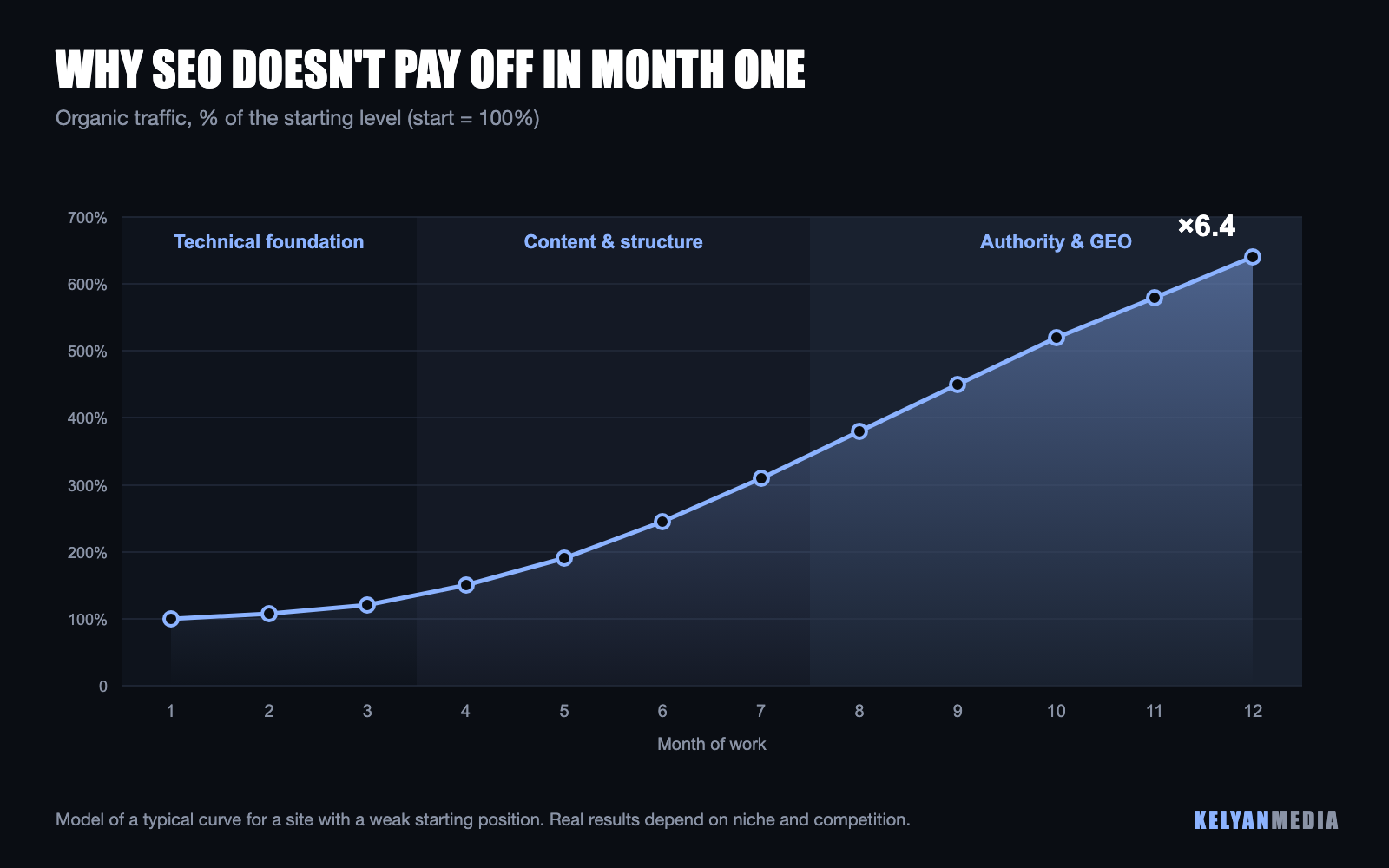
The first months go into the technical foundation: fixing indexing errors, speed and site structure. Traffic barely moves, but without this stage, investment in content and links only works at half strength. Then content kicks in — new pages targeting real customer queries — and growth accelerates. By the second half of the year authority builds up: the site ranks for increasingly competitive queries and starts appearing in AI answers.
That’s why SEO should be treated as an investment rather than a one-off campaign. Unlike paid ads, the traffic doesn’t disappear the day you stop paying.
The SEO cycle: six stages
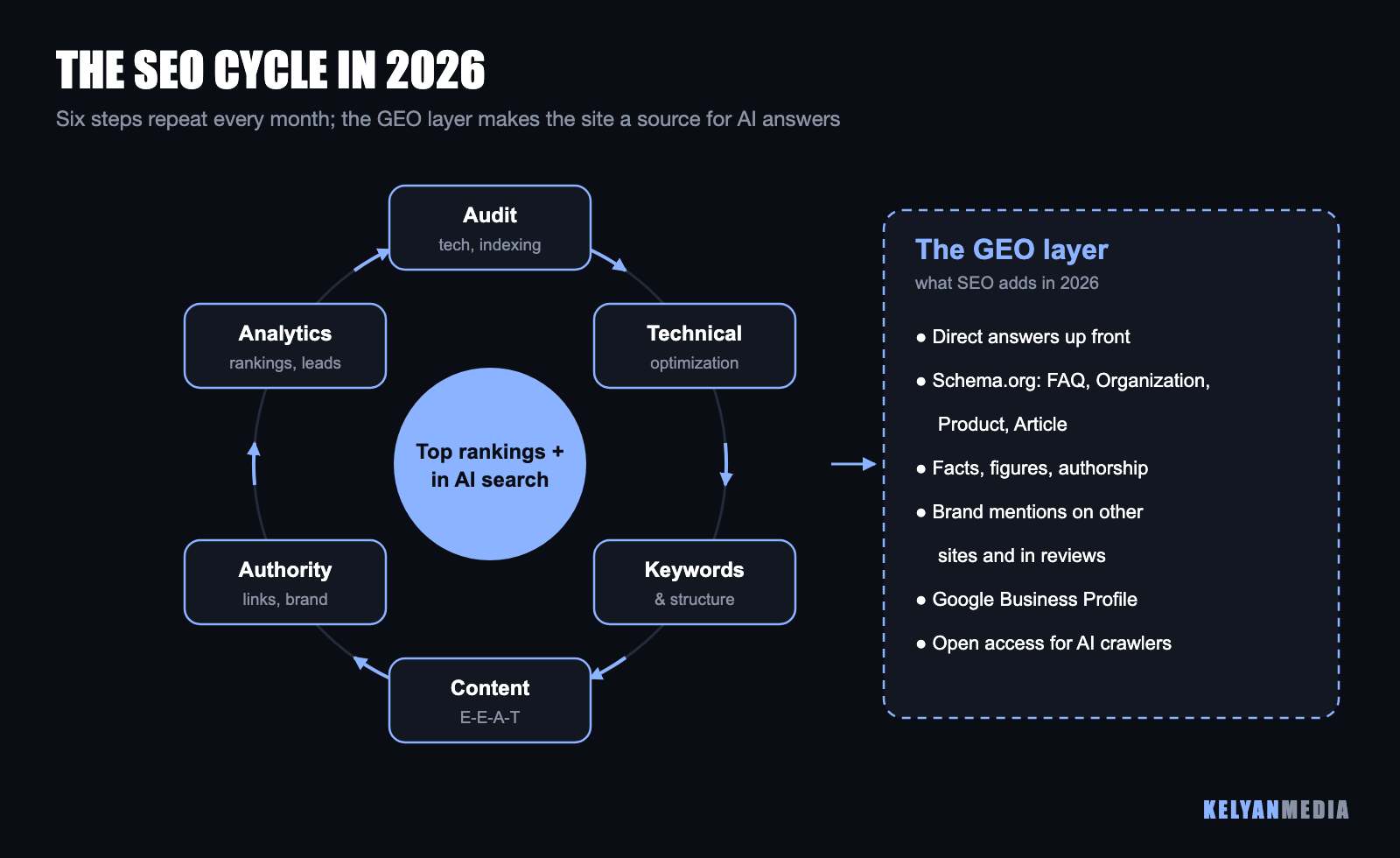
Modern SEO isn’t a to-do list you complete once — it’s a cycle. Every month the team goes through it again, analyzes what worked and shifts effort to where the return is highest.
1. Audit
We check how the search engine sees the site: which pages are indexed, whether there are duplicates, 404 errors, mobile issues or slow pages. In parallel we analyze competitors in the top 10: their site structure, content depth and backlink profile.
2. Technical optimization
Page speed (Core Web Vitals), correct robots.txt and sitemap.xml, canonical URLs, redirects, HTTPS, mobile responsiveness and Schema.org markup. This is the foundation: if a crawler can’t navigate the site properly, nothing else will deliver.
3. Keywords and structure
We collect the queries people use to search for your services and products and group them by intent. Each group gets its own page. A common mistake is a single “Services” page instead of dedicated landing pages for each service and each city.
4. Content built on E-E-A-T
Content answers real customer questions and includes numbers, examples, photos of your own work and a named expert author. A good test: could a competitor write the same text without knowing your business? If yes, it’s too generic.
5. Authority: links and brand
Publications on industry sites, mentions in media, directories and maps, customer reviews. In 2026 what matters is quality and naturalness, not volume: one article on a relevant industry portal is worth more than a hundred links from questionable sites.
6. Analytics
Rankings and traffic — but above all, leads and sales from organic search. SEO that brings visitors but not customers needs to be re-aimed: you may be targeting informational queries instead of commercial ones.
GEO: optimizing for AI answers
GEO (Generative Engine Optimization) is a set of practices that increase the chance that ChatGPT, Gemini, Perplexity or AI Overviews will cite your site. It isn’t a separate service — it’s a layer on top of classic SEO.
- Direct answers up front. Language models readily cite pages that answer the question in the first two or three sentences and only then go into detail.
- Structure. Clear headings, lists, tables and Q&A blocks. It’s easier for a model to extract a fact from a table than from a wall of text.
- Schema markup. Schema.org for your organization, products, articles, FAQs and reviews helps machines understand unambiguously what a page is about and who stands behind it.
- Facts and sources. Specific numbers, dates, author names and links to primary sources build trust with both people and models.
- Off-site brand mentions. Models form their view of a company from across the web: reviews, articles, map and directory listings.
- Access for AI crawlers. Make sure robots.txt and bot-protection settings don’t block search and AI crawlers if you want to appear in their answers.
What to check on your site today
| Question | Where to look | Red flag |
|---|---|---|
| Are all key pages indexed? | Google Search Console → Indexing | Service or product pages marked “Not indexed” |
| Does the site load fast on mobile? | PageSpeed Insights | Mobile score below 50 |
| Is there a separate page for each service? | Site menu structure | All services on one page |
| Do articles show an author and date? | Any blog post | Anonymous, undated content |
| Is your Google Business Profile complete? | Google Maps | No photos, hours or reviews |
| Is there schema markup? | Rich Results Test | Errors or no markup at all |
If two or more answers are red flags, start with a technical audit — not with buying links or writing new content.
What SEO costs and how to evaluate an agency
Pricing depends on competition in your niche, the size of the site and the target region. But there are warning signs to watch for when choosing an agency:
- promises of “#1 in a month” or guaranteed specific rankings;
- reports that show only rankings, with no traffic or leads;
- buying hundreds of links in the very first month;
- unwillingness to explain what work is being done and why.
A good agency is honest about timelines, shows a 3–6 month work plan and reports not just rankings but customer enquiries.
The KelyanMedia team runs SEO projects with GEO optimization built in: from technical audits to content strategy and brand-mention work. To get a promotion plan for your site, fill out our SEO brief.
FAQ
Do we still need SEO if traffic is moving to AI answers?
Yes. AI answers are built from sites that already rank well and earn trust. Without classic SEO it’s nearly impossible to become an AI source. Besides, commercial queries (“buy,” “order,” “price”) still lead to websites.
How many months until SEO starts generating leads?
Ranking changes usually show in 2–3 months, and a meaningful increase in leads in 4–6 months. For new sites and highly competitive niches it can take longer.
How is GEO different from SEO?
SEO optimizes a site to rank in search results; GEO optimizes it to be cited in generative AI answers. In practice they’re one continuous effort: structured expert content, technical health and brand authority are needed for both.
Can you do SEO without a blog?
You can, if you have enough well-developed commercial pages. But a blog helps capture informational queries, demonstrate expertise and become a source for AI answers, so in competitive niches it almost always pays off.